
Most industrial facilities have electrical systems that grew piece by piece over years, added on whenever a new piece of equipment showed up. That approach works until it doesn’t, usually right around the time a facility tries to automate or scale and discovers the electrical infrastructure was never designed to work as one system. Integrated Electrical Services exist specifically to fix that, tying power distribution, controls, and equipment together instead of leaving them as disconnected additions.
Integration sounds like a technical detail, but it affects almost everything else in a facility’s operation. Downtime, energy costs, equipment reliability, and even how quickly problems get diagnosed all trace back to whether electrical systems were built to work together or just happen to coexist. It’s rarely the first thing anyone thinks to fix, which is exactly why it tends to sit unaddressed for years.
Disconnected Systems Create Hidden Inefficiencies
A facility with electrical systems added incrementally over the years often ends up with redundant panels, inconsistent controls logic, and power distribution that wasn’t planned around actual load patterns. None of this looks like a problem day to day, but it shows up in ways that are easy to miss.
Energy costs run higher than they should because power isn’t being distributed efficiently across the facility. Diagnosing an issue takes longer because technicians are working across systems that don’t share data or communicate with each other. Even scheduling maintenance gets harder when nobody has a clear picture of how everything connects.
None of these problems are dramatic on their own. Together, they add up to a facility that’s running less efficiently than it could be, without anyone being able to point to one specific cause.
This is part of why integration issues are so easy to live with for years. There’s no single failure that forces the conversation. It’s a slow accumulation of small inefficiencies that only becomes obvious once someone actually maps out how much time and money the disconnected systems are quietly costing.
Integration Makes Automation Actually Work as Intended
Automated equipment depends on electrical and controls systems that communicate cleanly with each other. A conveyor system, a robotics cell, and a warehouse control system all need to share data and respond to each other in real time, and that only works if the underlying electrical infrastructure was built to support it.
Facilities that automate on top of disconnected electrical systems often run into problems that look like equipment issues but are actually integration issues. A sensor that isn’t communicating properly with a PLC, or a controls system that can’t get accurate data from power monitoring, creates the kind of intermittent problems that are hard to diagnose because the root cause isn’t the equipment itself.
Proper integration solves this at the source, making sure the systems automation depends on are actually built to talk to each other instead of operating in isolation and hoping for the best.
Centralized Controls Change How Problems Get Solved
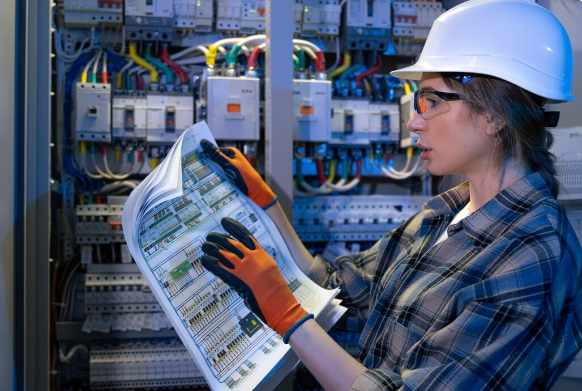
One of the biggest practical benefits of integrated electrical systems is centralized monitoring. Instead of technicians checking multiple disconnected panels or systems to figure out what’s happening, an integrated system gives one place to see power distribution, equipment status, and fault conditions across the facility.
This matters more during a problem than people expect. A facility with centralized monitoring can often identify the source of an issue in minutes. A facility with disconnected systems might spend hours ruling out possibilities before finding the actual cause, and that time adds up fast when production is stopped and waiting.
Working with a commercial general contractor that plans electrical integration alongside the rest of the facility, rather than treating it as a separate trade to coordinate later, tends to result in systems that were actually designed to be monitored and diagnosed centrally from day one.
Integration Reduces Long-Term Maintenance Costs
Disconnected electrical systems are harder and more expensive to maintain, mostly because there’s no single source of truth for how everything is configured. Technicians end up relying on tribal knowledge or outdated documentation to understand how a specific circuit or control loop actually works.
Integrated systems typically come with better documentation by default, because integration requires mapping out how everything connects in order to build it properly in the first place. That documentation pays off every time maintenance needs to happen, since technicians aren’t starting from scratch trying to understand a system that was never fully documented.
Over time, this reduces both the labor cost of maintenance and the risk of mistakes that happen when someone’s working on a system they don’t fully understand.
Scalability Depends on Integration More Than People Realize
Facilities planning to grow or add automation in phases run into a common problem: the electrical infrastructure that worked for phase one wasn’t built with phase two in mind. Adding capacity later means retrofitting systems that weren’t designed to expand, which is more expensive and disruptive than building in that flexibility from the start.
Integrated systems, planned with future phases in mind, avoid a lot of this. Panel capacity, controls architecture, and power distribution can all be designed with room to grow, so adding equipment later is an expansion rather than a redesign.
This is one of those investments that’s easy to defer because the payoff isn’t immediate. But the facilities that plan for scalability upfront are the ones that add automation or expand operations without the disruption and cost of ripping out electrical infrastructure that was never meant to support what the facility eventually became.
If your facility is dealing with electrical systems that have grown piecemeal over the years, or you’re planning automation that depends on better integration, it’s worth having that conversation before the next project moves forward. You can Let’s Connect to talk through what integration would actually look like for your current setup and where the biggest gains are likely to come from.
Why This Matters More as Facilities Get More Complex
The more automated and technically complex a facility becomes, the more integration matters. A simple facility can get by with disconnected electrical systems because there’s not much that depends on them working together. A facility running automation, robotics, and controls-heavy processes doesn’t have that luxury.
Facilities that invest in proper electrical integration end up with systems that are easier to maintain, cheaper to run, and ready to support whatever gets added next. That’s a very different position than facilities still working with electrical infrastructure that was never designed to be anything more than a collection of individual additions over time.